Spatial Fabrication Studio

Final Models

My proposed sleeping platform design continues the light box, fluid effect (of the threshold) throughout the gallery space. In the process of design thinking I really liked the idea of continuing the platform from the threshold, that showed a bold narrative behind making the models.

When creating my 1:20 detailed model I had to consider sound and chose materials that would absorb it, such as wood. I also chose reflective surface materials, such as plastic, mirror and aluminium that continue the idea of fluidity and distortion, similar to the materials I used in my previous projects this semester.
I found drawing my design as a 1:20 section was very useful, as I could build on that template. Unfortunately because of my lack of knowledge using 3D drawing software, I was not capable of laser cutting my waffle structure, so I instead hand created it using cardboard. When building solid materials on top of my waffle cardboard structure, I realised that I had to strengthen the structure, so I used balsa wood to help keep the shape. At the end I went a step further and added fairy lights into the platform which gave a whole new feeling and showed a dream-like state.

The process of making my 1:20 model took much longer than expected, however I am very pleased with the result. While creating my sleeping platform design from digital, clay to cardboard and wood I have learned a lot about making models.

Materials I used:
– White cardboard
– Bulsa wood
– Bamboo
– Black cardboard
– Acrylic paint
– Purple satin
– Sponge
– Printing paper
– Transparent PVC sheet
– Fairy lights with battery
– PVA glue
– Tape
– Aluminium sheet
– Mirror
– Pins

Model Exploration

I still was not impressed with my design, so I did some more sketches refining my design even further.

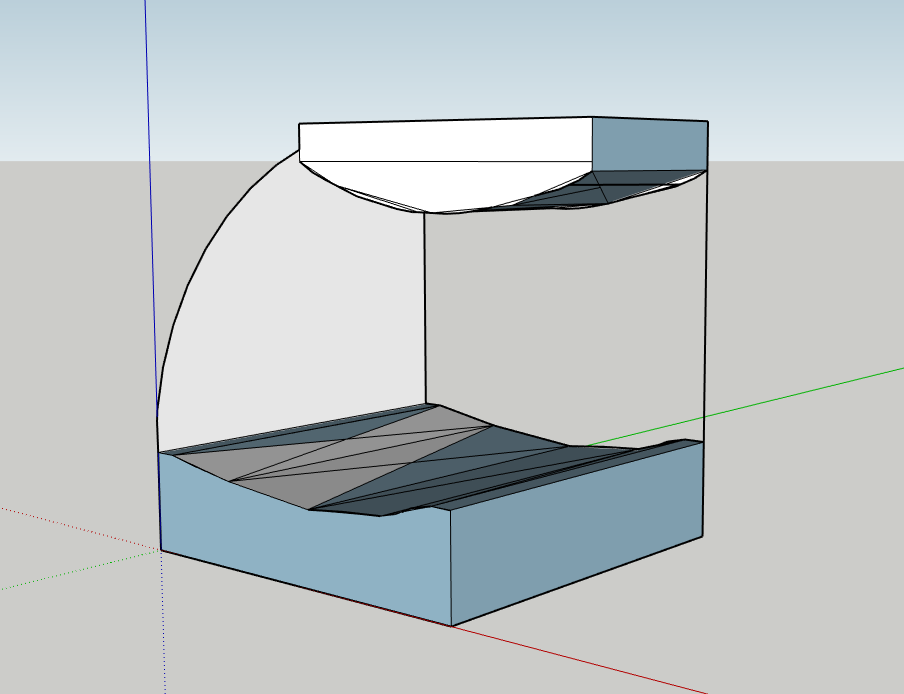
Modified 1:50 model.

I attempted to draw my design in 3D, however with the little knowledge I have for digital drawing, the result did not come out exactly as what I was expecting.

I have made models from cardboard, clay and digitally now. With all this modifying, I feel like I am starting to finalise on idea for my final 1:20 and 1:50 models.

Refined Model – Rhino

I reattempted to draw up my modified design but this time using Rhino software. Although the result being much more successful, I did not have the skills to 3D print out my proposed 1:50 model.

Material Research

Grasshopper Tutorial Waffle Structure
Om. egvo

To make the waffle structure for my model, I will need to draw up the structure digitally and later on 3D print or laser cut it. I have little experience with 3D digital drawings, so this may be a challenge. Otherwise I will have to think of an alternative decision on how to make the structure of my model.

One of my options is to make my light box sleeping platforms of acrylic and leave the waffle structure showing, so the light can bounce between the shapes and could create come amazing light patterns. However to achieve that I will need to do more research into waffle structuring and cutting acrylic.

Precedent

1.

(retrieved from mwarchitects.co.nz/project/amano
https://jackmckinney.co.nz/project/amano/).

Amano is a restaurant, designed by a New Zealand Architects Jack McKinney and Bryan Windeatt (2017), located in Britomart, Auckland.

I was interested with the how the counter benches lit up/created a glow, also the shell being made entirely of mother of pearl. With my design threshold including a light box, I felt these beautifully made counters could inspire me with creating the sleeping platforms.

2.

Shigeru Ban Architects – ‘Nine Bridges Country Club’.

(retrieved from: https://www.arch2o.com/nine-bridges-country-clubshigeru-ban-architects/
https://www.pinterest.nz/pin/232779874462488546/?lp=true)

Nine Bridges Country Club was designed by a Japanese Architect Shigeru Ban in 2009, located in Yeoju-gun, Gyeonggi-do, South Korea. Ban is known for his innovative art work who uses recycled cardboard to create interesting sculptures and buildings, even locally such as the Cardboard Cathedral, located in Christchurch.

I was intrigued by how the ceiling of the Nine Bridges Country Club looked like an unfinished structure, similar to waffle structuring and still looks incredible. Similar to my idea of the acrylic waffle structure, Ban’s design conveys the same idea as I am hoping to achieve for my sleeping platforms.

PROJECT 3 SLEEP / WAKE: TWO PLACES TWO STRANGERS

To start off our third project Sleep/Wake Two Strangers, we started by sketching ideas for designing our sleeping platform to fit into our gallery space. I sketched up a few ideas that related to my proposed threshold I designed previously in Project 2.

My initial idea when sketching was to somehow compliment the curved ceiling threshold I designed in the last project. I tried to show the curve in different ways while sketching roughly. I guess the very first idea I had in mind was to elevate the platform. I tried keeping the model design simple, as my proposed threshold of the gallery was quite complicated.
I decided on the drawing shaded in.

Clay Model 1:50 (refining my idea)

I did more sketching on modifying my design, and once I sort of had refined my idea, I did not know how I was going to physically build it. I attempted to make it out of clay, however I worked out during the process of building that it was difficult to hold up the top platform. Overall, personally I found that the clay model was too bulky and simple.

Abstract Writing

28 April 2019

Exploring thresholds making people aware from a public busy city to the sleep/wake area. 

For Project Two I continue to explore the idea of Blur, Fluidity, Weightlessness, Distortion, Disturb, Softness as I did in Project 1.

In my Proposed Threshold Model the reflective distorted doors show the fluidity and distortion and the large ceiling light screen above is a similar idea to my light display model I made in the previous project.

The site investigations made me consider the relationship of the ST Pauls St Gallery 3 and Albert Park between the busy road (Wellesley St East). I was thinking about the history and memory of this place and tried to imagine the thousands of people who were there before (yesterday and 600 years ago). While the intervention I’ve designed is able to let sound through the doors, they can close shut at anytime and block off the loud street noises.

Threshold Proposal Model

I feel as if I have clearly communicated my ideas (blur, fluidity, weightlessness, distortion and disturb) through my proposed threshold model and broken the ordered reality of the existing gallery with fluidity, light and softness. The threshold starts from the top of the stairs (outside), into the lobby and gallery and continues to the back wall of the stairs down to the gym.

The light-box pattered dome ceiling is very similar to my project one model of the curved acrylic screen with patterns scratched onto it, except i’ve transformed what was a light display to a into a light dome ceiling.
The distorted mirror doors give my model an interesting effect, when the light bounces off the reflective surfaces creating soft shadows of the pattern from the light-box patterned dome ceiling.
The columns symbolise the colonials that built on-top of what was once Maori land, and the silhouette figures reflect back on the colonials, pre colonials and people who had been in that space in the past.

Materials I used:

  • Thin white cardboard
  • Mirror-like reflective surface
  • Transparent PVC sheet
  • Black cardboard
  • Printing paper
  • Bronze thin metal rods
  • DVD cases
  • PVA glue
  • Sellotape
  • Gorilla tape

Site Drawings

Site Survey Plan 1:50
Legend: Pencil = Light | Red = History | Yellow = Sound

The site survey plan above shows light, sound and history. I traced the Felton Mathew plan on my drawing because I wanted to link the connection between that and the gallery through the colonial reality of Auckland city. I felt as if they both were straight forward and showed aspects of order and simplicity. In our site visit I was interested in the shadows made by the people on the floor and was inspired by one of the photographs I took. I noticed the gradation from the front to the back of the gallery and how the overall space did not have much light.

Continuing on from Project 1, when creating my threshold I made sure to keep on the original five main ideas – blur, fluidity, weightlessness, distortion and disturb. Unlike the ordered reality and plainness of ST Pauls St Gallery, I had a mindset of breaking the symmetry and giving the threshold more fluidity.

Precedent

1.

Jaume Plensa – ‘Mirror’ 2011

https://moody.rice.edu/art/jaume-plensa

This is an artwork by artist Jaume Plensa located Outside of Herring Hall on the campus of Rice University, Houston, Texas.

His artwork is a laser cut sculpture of two figures, made out of some reflective surface. I thought this would inspire designing my ideal threshold, as the figures relate to the silhouettes in my A1 site map collage and I could use similar mirror material to reflect patterns and light around my threshold design. I also how you can see through the laser cut metal creating dappling effects and patterns.

2.

Cheshire Architects – ‘Milse’

http://cheshirearchitects.com/projects/milse/

‘Milse’ is a contemporary dessert bar and was built by Cheshire Architects in 2013, and is located in Britomart, Auckland.

I was interested in the fragmentation of the laser cut ‘lattice bound corridor’ and how the surface is distorted and modulated. In a way the ceiling is similar to the acrylic light screen with engraved patterns that I previously made for my project one model. I think the biggest aspect of the dessert bar ceiling that I found lovely is the shadows reflected onto the interior, creating a comforting, warm feel to it.